 Orbital Focus
Apollo 12 Lightning Strike: The First Three Minutes and Why "SCE to Aux" Worked
Lightning hit Apollo 12 twice in its first minute. A flight controller recognized a pattern he had once chased after a late-night test, and the telemetry came back in under two minutes. Here is the transcript, second by second.
 By Chris HabibUpdated 10 min read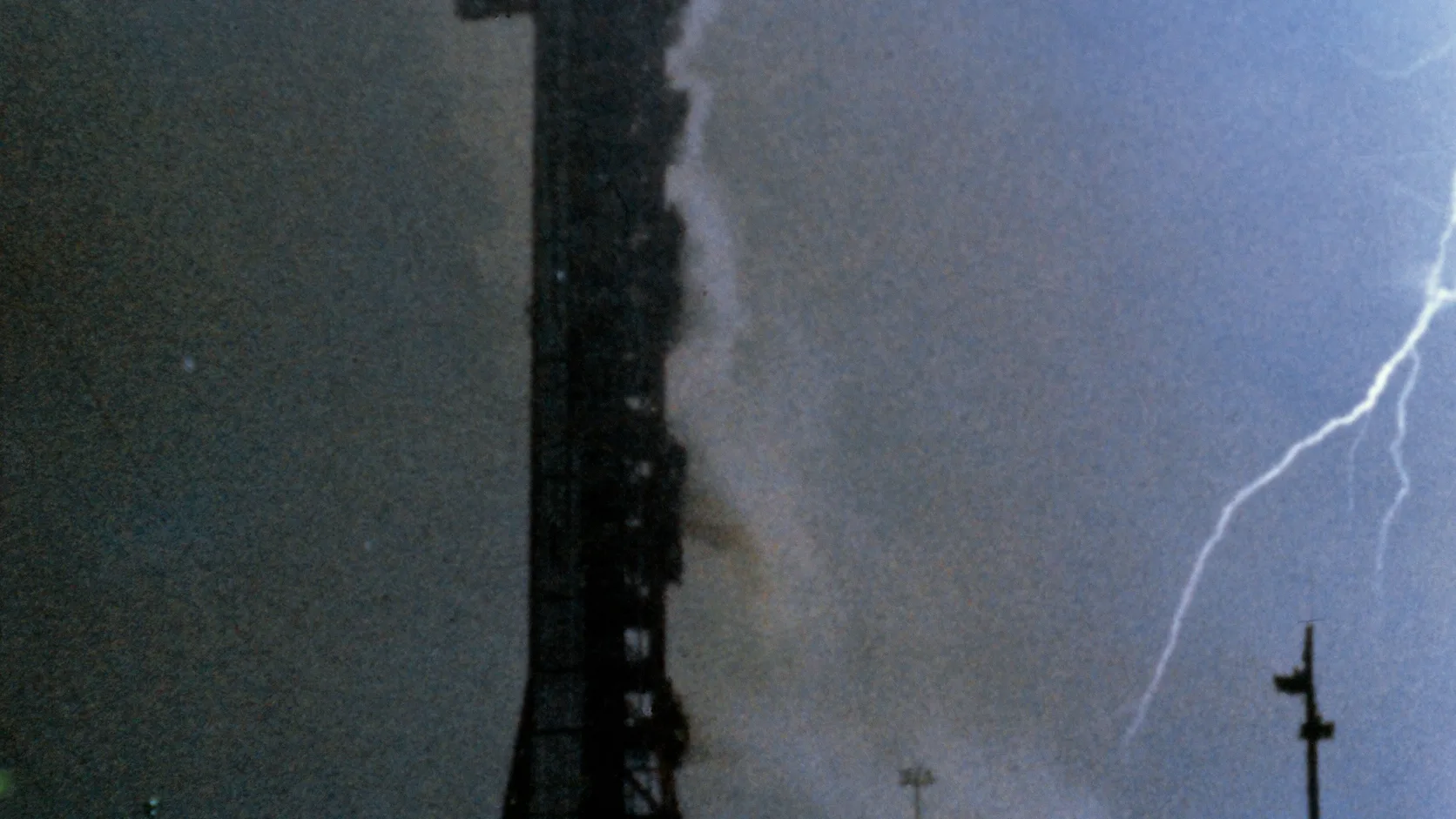
The bottom line
Lightning struck Apollo 12 at 36.5 and 52 seconds after liftoff. The Saturn V kept flying, but the spacecraft's fuel cells dropped off line and Mission Control's data turned to nonsense. EECOM John Aaron recognized the pattern, called "SCE to Aux," Alan Bean flipped the switch, and power and data were back by about 2 minutes 22 seconds.
Apollo 12 was hit by lightning twice on November 14, 1969: 36.5 seconds after liftoff and again at 52 seconds. The Saturn V rocket kept flying on its own guidance, but the Command Module lost all three fuel cells, its guidance platform tumbled, and the data reaching Mission Control turned to nonsense. A three-word call, "SCE to Aux," brought the data back, and the crew had the fuel cells on line again about 2 minutes and 22 seconds into the flight.
Watch the 47-second version on Orbital Focus's Instagram or TikTok. This page is the long version: the transcript second by second, what the switch actually did, which popular details are wrong, and a small checklist built from how John Aaron prepared for a problem nobody had simulated.
Ownership and method
Red Honey publishes this guide and makes Orbital Focus. Every quote below comes from NASA's Apollo Flight Journal transcript, the 1970 NASA lightning analysis, or the NASA Johnson Space Center oral histories of John Aaron and Gerry Griffin, linked in the sources. Where the sources disagree, we say so. No one named here endorses the app.
What happened
Apollo 12 lifted off from Launch Complex 39A at 11:22 a.m. EST, into low rain clouds. NASA's post-flight analysis concluded that the rocket and its long exhaust plume triggered the lightning itself, something no one had considered before the flight. The first discharge came at about 6,400 feet, the second at about 14,400 feet.
Three things went wrong at once in the spacecraft:
- Power. All three fuel cells disconnected from the power buses. The Command Module's two entry batteries carried the 75-amp load alone, and the bus voltage sagged to about 24 volts.
- Guidance. The second strike made the spacecraft's inertial platform lose its reference and start to tumble.
- Data. The lightning knocked out the primary power supply of the Signal Conditioning Equipment (SCE), so the numbers streaming to Houston no longer made sense.
The Saturn V's own instrument unit, which was steering the rocket, was essentially unaffected. That detail matters later.
Minute-by-minute timeline
Times are ground elapsed time from liftoff, as printed in the Apollo Flight Journal. "Onboard" lines came from the cockpit recorder and were not heard in Houston at the time. The last column is our annotation.
| Time | What was said or happened | What it tells you |
|---|---|---|
| 0:00 | Conrad: "Lift-off. The clock's running." | Normal start in rain and cloud. |
| 0:36.5 | First strike. Fuel cells drop off line; batteries carry the load; SCE loses its primary power. | Three failures arrive at once, which makes the cause hard to see. |
| 0:39 | Gordon (onboard): "I lost a whole bunch of stuff; I don't know..." | The crew sees symptoms, not a cause. |
| 0:52 | Second strike. The guidance platform loses its reference and begins to tumble. | A second symptom stacks on the first. |
| 1:02 | Conrad: "Okay, we just lost the platform, gang. I don't know what happened here; we had everything in the world drop out." | The commander reports plainly and keeps flying. |
| 1:12 | Conrad: "I got three fuel cell lights, an AC bus light, a fuel cell disconnect, AC bus overload 1 and 2, Main Bus A and B out." | An exact list of what is lit. Precise reports make pattern-matching possible. |
| 1:30 | Bean (onboard): "Twenty-four volts, which is low." | The bus normally ran near 28 volts. |
| Just before 1:36 | On the flight director loop, Aaron: "Flight, EECOM. Try SCE to AUX." Griffin: "Say again? SCE to AUX?" | The fix arrives as four words. Almost nobody on the loop knows the switch. |
| 1:36 | CAPCOM Gerry Carr: "Apollo 12, Houston. Try SCE to Auxiliary. Over." | The ground relays it to the crew. |
| 1:39 | Conrad: "Try FCE to Auxiliary." | The readback is wrong. |
| 1:43 | Carr: "SCE, SCE to auxiliary." | Carr repeats it. |
| 1:50 | Conrad (onboard): "SCE to Aux." | Bean has set the switch. In Houston, the data starts to make sense again. |
| 2:19 | Carr: "Apollo 12, Houston. Try to reset your fuel cells now." | With readable data, the ground can see what actually failed. |
| 2:22 | Fuel cells reconnected to the power buses, per the post-flight mission report. | Under two minutes from first strike to power restored. |
| 2:42 | First and second stages separate. | The rocket stayed on its planned path throughout. |
| 2:53 | Conrad: "Okay. Now we'll straighten out our problems here. I don't know what happened; I'm not sure we didn't get hit by lightning." | The famous deadpan line. |
| 3:03 | Conrad: "Okay. I have a good GDC, and Al has got the fuel cells back on, and we'll be working on our AC buses." | Recovery confirmed. |
| 3:17 | Conrad: "Think we need to do a little more all-weather testing." | Humor returns about 2 minutes 40 seconds after the first strike. |
The mission went on to the Moon. Five days after launch, Conrad and Bean landed Intrepid about 535 feet from Surveyor 3, a robotic lander that had been sitting there since April 1967, and brought pieces of it home.
What SCE to Aux did
The Signal Conditioning Equipment took readings from sensors around the spacecraft and converted them to a standard 0 to 5 volt range, so other electronics could turn them into numbers for recording and transmission to Earth. When the lightning knocked out the SCE's primary power supply, the numbers Houston saw were garbage. Mission Control could not tell which systems had actually failed.
The SCE power switch sat at the bottom of Panel 3, in front of Lunar Module Pilot Alan Bean, with three positions: OFF, NORMAL and AUX. Moving it to AUX ran the unit from its auxiliary supply. It did not fix the fuel cells. It fixed the view of them, which let the ground tell the crew exactly what to reset.
Gerry Griffin, the flight director, put it bluntly in his 1999 oral history: "I'd never heard of the switch. We'd never touched it. Never used it, out of all those hundreds of switches."
Why Aaron knew
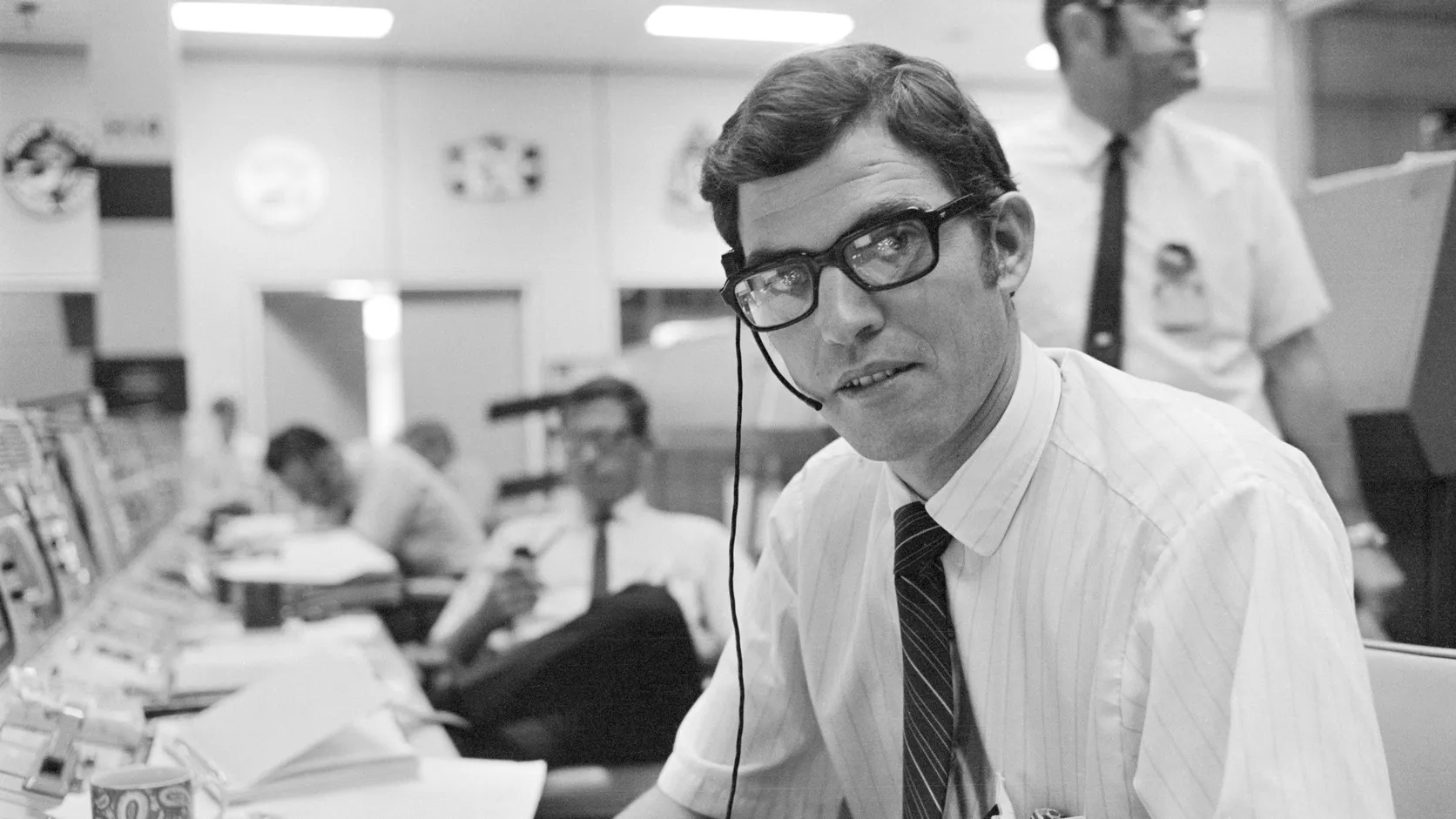
John Aaron was the EECOM, the flight controller responsible for the spacecraft's electrical and environmental systems. In his 2000 oral history, he explained that in Houston's simulators a power failure like this made the readings drop to zero. On Apollo 12 they did not.
He had seen the real signature once before. "I happened to be on the third shift one night watching a test of the command module that they were performing at Kennedy," he said. The test crew dropped all power on the vehicle to go on battery, and the numbers "didn't go to zero. They were at 6.7, 12.3. I mean, some squirrelly kind of numbers."
He did not let it go. "I drove home that night, thinking where did those squirrelly numbers come from. And the next morning I came in the office and I sat down with Dick Brown," a North American engineer in his office. "We sat down and went through all the circuitry to find out just how does this thing work."
His own summary is modest: "The way luck played into that was, again, luck and curiosity." And: "So it wasn't that I understood exactly what had happened, I recognized a pattern and how to get out of it."
Myths and corrections
Retellings of this story drift. These are the details most often wrong, checked against the primary sources.
| Popular version | What the sources say |
|---|---|
| Aaron had seen the pattern in a simulation. | It was a real test of the command module at Kennedy, on the third shift. Aaron says the simulator showed zeros instead. Griffin calls it "a pad test." |
| Aaron was at Kennedy that night. | Unclear. He was "watching a test ... they were performing at Kennedy," then drove home and came "in the office" the next morning. |
| The test was "about a year earlier." | Aaron's own account gives no date. Only secondary sources say this. |
| CAPCOM Carr asked "What the hell is that?" | The transcript puts "What the hell is that?" in Conrad's mouth, on the onboard recorder only. Griffin recalls Carr just saying "What?" |
| Dick Gordon told Bean to flip the switch. | Not in the transcript. Griffin and the Apollo Flight Journal credit Bean. |
| Aaron was 23, or 24, or 26. | Sources conflict and no NASA source we found gives his birth date. Griffin describes him as "a young flight controller." |
| Apollo 12 was seconds from an abort. | Griffin says he thought they would have to abort, but chose not to abort early while the rocket kept gaining altitude. Conrad said in the 1969 debrief, "I never considered any kind of an abort." Losing telemetry alone was not grounds for an abort. |
One quote carries a caveat: Aaron's exact words "Flight, EECOM. Try SCE to AUX." come from the Apollo Flight Journal's transcription of the flight director loop audio. The official 1969 transcript covers only air-to-ground, where the words the crew heard were Carr's: "Try SCE to Auxiliary."
After the flight, NASA amended its launch rules so that no launch would be attempted in weather where lightning was likely to form.
The pattern card
Aaron did not solve a problem he had studied for. He had noticed an odd reading once, refused to leave it unexplained, and traced it through the circuitry the next morning with a colleague. That habit translates to debugging code, fixing a machine, or studying a subject where the practice problems do not look like the real test.
This is an editorial routine drawn from his account, not a tested study method.
| Step | What Aaron did | Your version |
|---|---|---|
| 1. Notice the mismatch | Readings sat at 6.7 and 12.3 when he expected zero. | Write down the exact odd result: the error text, the wrong answer, the value that surprised you. |
| 2. Keep the question | He drove home asking "where did those squirrelly numbers come from." | Phrase it as one question before you stop for the day. |
| 3. Trace it soon | The next morning he went through the circuitry. | Schedule a short block to trace it through the source: the documentation, the derivation, the worked example. |
| 4. Bring someone who knows | He sat down with Dick Brown, an engineer who knew the hardware. | Ask the person, teacher, or reference that knows the system better than you. |
| 5. Compare practice with reality | The simulator read zeros; the real spacecraft did not. | Note where your practice setup differs from the real exam or production system. |
| 6. Save the exit | "I recognized a pattern and how to get out of it." | Record the symptom and the fix together, on one card. |
A blank card to copy:
| Field | Your entry |
|---|---|
| The odd result, exactly | |
| The question it raises | |
| Where I will trace it | |
| Who can check my reasoning | |
| How practice differs from the real thing | |
| Symptom, then the fix |
Griffin's side of the story adds one more habit: before touching anything, he checked what was still working. "I remember looking down at those five engines, and they were all still right on the money pressure wise," he said, and the rocket was "gaining altitude right up the flight dynamics officer's preplanned plot." When something breaks, confirm what has not broken before you change anything.
If the odd result shows up mid-task, park it in a list with the brain dump method instead of chasing it right away. When a missing piece of understanding stalls a study session, the studying recovery guide covers how to tell a knowledge gap from a distraction. For step 3, a 10-minute timer is enough to start the trace. In Orbital Focus you can name the mission's payload after the question, such as "Why didn't the readings go to zero?", so the session has one job. The payload guide explains how that works.
Frequently asked questions
What does SCE to Aux mean?
SCE is the Signal Conditioning Equipment, the unit that converted readings from the spacecraft's sensors into a standard 0 to 5 volt form before they were digitized for recording and transmission to Earth. Aux switched it to its auxiliary power supply. After the lightning knocked out its primary supply, that switch brought readable data back to Mission Control.
Did lightning almost make Apollo 12 abort?
Flight director Gerry Griffin later said he thought they were going to have to abort. He also decided not to abort early while the Saturn V was still climbing on its planned path, and Pete Conrad said in the 1969 debrief that he never considered an abort. Under the launch rules, losing telemetry alone was not grounds for an abort.
Who flipped the SCE switch on Apollo 12?
Lunar Module Pilot Alan Bean. The switch sat at the bottom of Panel 3, in front of his seat. Griffin's oral history and the Apollo Flight Journal both credit Bean; the popular version in which Dick Gordon told him to do it does not appear in the transcript.
Sources
All sources checked September 24, 2026.
- Apollo 12 Flight Journal, Day 1 Part 1: Launch to Earth Orbit. Air-to-ground and onboard transcript with commentary; source of every timestamped quote, the SCE description, the 75-amp and 28-volt figures, the 2:22 fuel cell reconnection and Conrad's debrief quote.
- More than SCE to AUX: Apollo 12 Lightning Strike Incident, Johannes Kemppanen, Apollo Flight Journal, updated February 15, 2025. Flight director loop transcription, Panel 3 location, abort-rule context and the amended launch rules.
- Analysis of Apollo 12 Lightning Incident, NASA, February 1970. Launch time, strike times and altitudes, triggered lightning and the SCE dropout.
- John W. Aaron oral history, NASA Johnson Space Center Oral History Project, January 18, 2000, pages 12-16 and 12-17.
- Gerald D. Griffin oral history, NASA Johnson Space Center Oral History Project, March 12, 1999, pages 12-9 to 12-15.
- Apollo 12: The Pinpoint Mission, NASA. Telemetry loss at 36 and 52 seconds, the 535-foot landing distance and Surveyor 3's April 20, 1967 landing.
Images: the hero frame is from NASA 16 mm launch-pad film (public domain), scanned by Ed Hengeveld for Project Apollo Archive, via Wikimedia Commons. The photo of John Aaron is NASA S69-59590 (public domain), via NASA on The Commons. Send corrections to habib225@gmail.com.
Orbital Focus turns a work session into a rocket launch; the real ones are more dramatic. If you want a mission of your own, try Orbital Focus.

Give your next focus block a destination.
Pick a mission length, launch, and keep distracting apps sealed until you arrive.
 Apollo 11 Quiz
 Focus Science Quiz
 One-Minute Mental Reset
 Permanent Daylight Saving Time in 1974