 Orbital Focus
How to Brain Dump: A 12-Minute Method That Ends in a Real Plan
Getting thoughts onto a page can create distance. The useful finish is deciding what to do, what to park, and what to let go.
 By Chris HabibUpdated 12 min read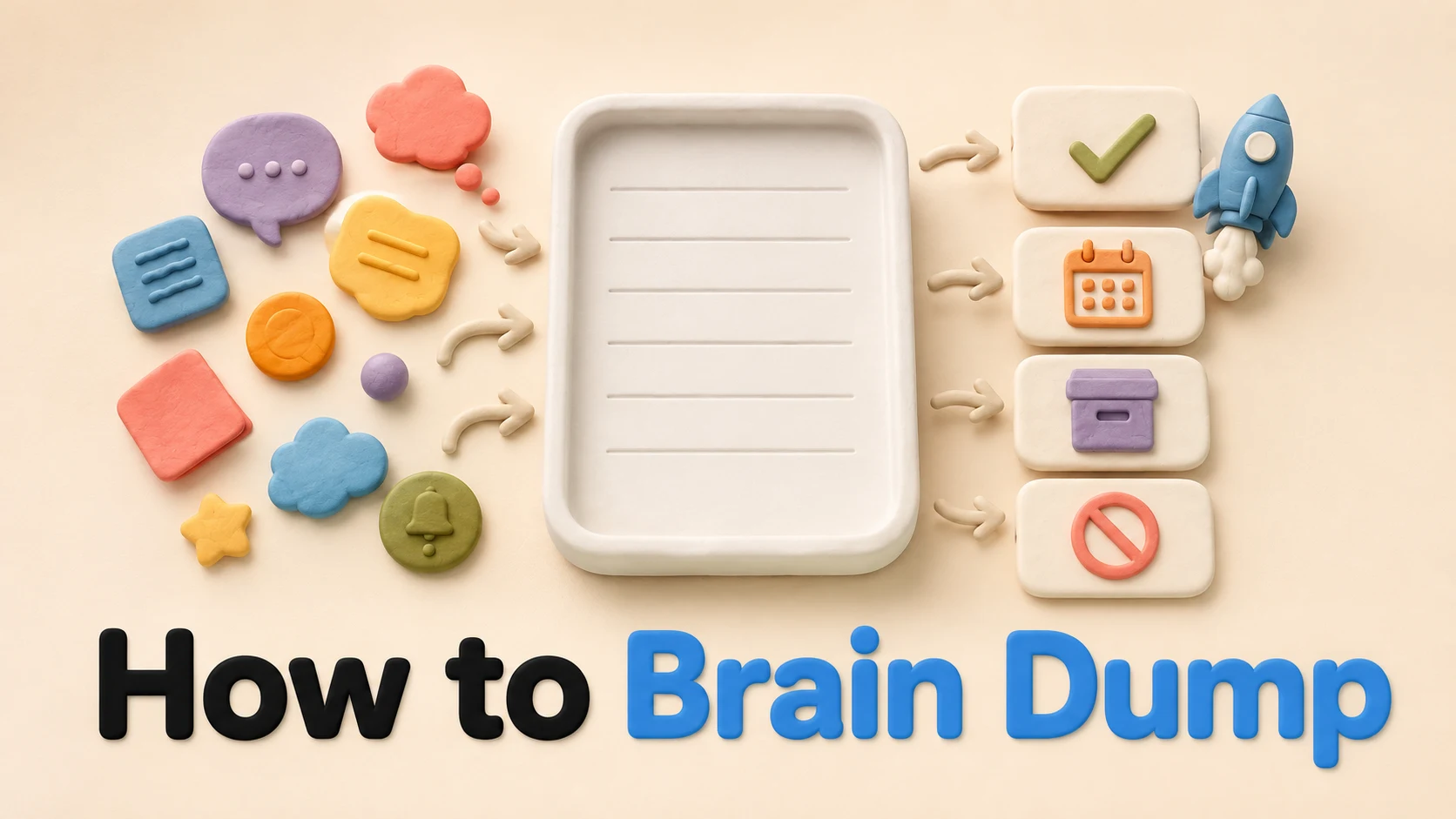
The bottom line
Set one horizon, capture for five minutes, label each item, and choose one visible action. A brain dump becomes useful when every item is committed, parked, delegated, or dropped.
A brain dump is often described as getting everything out of your head. That is a useful start, but it can leave you with the same obligations in a more intimidating shape.
The method below adds the missing half: process the page until you have one startable action and a trusted destination for the rest.
The quick answer
Set a 12-minute boundary. Capture one thought per line for five minutes, then label each item as an action, project, waiting item, idea, concern, or something to drop. Choose one main focus block and up to two small maintenance actions. Calendar, delegate, store, or delete everything else.
The objective is not an empty mind. It is fewer unresolved decisions competing for attention.
Red Honey publishes this guide and makes Orbital Focus. The app appears only at the end, where a fixed timer can help you begin the decision you already made.
The Brain Dump to Focus Plan worksheet
Use paper or one plain note. A complicated capture system gives you more choices at the exact moment you need fewer.
Capture Bay
Choose one horizon: today, this week, this project, or before bed. Then fill one item per row.
| Raw thought | Type | Is there a next action? |
|---|---|---|
| A / P / W / I / C / D | ||
| A / P / W / I / C / D | ||
| A / P / W / I / C / D | ||
| A / P / W / I / C / D | ||
| A / P / W / I / C / D |
Type key: A = action, P = project, W = waiting, I = idea or reference, C = concern with no clear action, D = drop.
Mission Plan
| Decision | Your answer |
|---|---|
| One result for the main focus block | |
| First visible action | |
| When and where it will happen | |
| Up to two maintenance actions | |
| Waiting items and who owns them | |
| Where ideas and references will live | |
| What I am dropping |
The 12-minute brain dump method
1. Choose one horizon, 30 seconds
“Everything in my life” is too large to process. Choose one boundary:
- what needs attention today;
- what is open this week;
- what is unresolved in one project; or
- what is circling before bed.
Write the horizon at the top. Thoughts outside it can go on a single “later” line.
2. Capture without organizing, 5 minutes
Write one item per line. Do not assign priorities, colors, dates, or folders yet. When you stall, use these prompts:
- What do I owe someone?
- What am I waiting for?
- Which decision am I delaying?
- What idea do I not want to lose?
- What maintenance task keeps resurfacing?
- What concern may not have an action?
If the page fills, keep going on a second page. The timer is the boundary, not the paper.
3. Mark the type, 90 seconds
Add one letter beside every line: A, P, W, I, C, or D.
A project is any result that needs more than one action. “Biology exam” is a project, not a next action. “Complete chapter 6 problems 1 through 8” is an action.
Do not force every concern into a task. Some concerns need a conversation, professional support, acceptance, or simply a place to be acknowledged.
4. Write the next visible action, 2 minutes
Process only the items that could matter soon. Begin with a verb and make the object visible:
- “presentation” becomes “write three possible opening lines”;
- “taxes” becomes “download the January bank statement”;
- “call dentist” becomes “find the clinic number and call at 9 a.m.”
If you cannot name the next action, the item may need a decision rather than more effort.
5. Commit, park, delegate, or drop, 2 minutes
Choose:
- one main focus block;
- up to two maintenance actions; and
- a destination for everything else.
Put time-specific commitments on the calendar. Move delegated items to a short waiting list with a name and follow-up date. Store ideas in one reviewable place. Cross out what you are not doing.
Writing what, when, and where makes a plan easier to execute than writing a vague intention. If the dump exposed too many active goals, use the capacity limits in the practical productivity guide.
6. Begin, 1 minute
Open the file, book, message, or tool required for the first action. Do one physical step before redesigning the list.
If a fixed finish line helps, use the 10-minute timer or launch an Orbital Focus mission for the block you chose. The app is the timer for the decision already made, not another place to reorganize the dump.
A worked brain dump example
| Raw item | Type | Processed result |
|---|---|---|
| Biology exam | Project | Complete chapter 6 problems 1 through 8 tomorrow at 4 p.m. in the library |
| Ask Maya about slides | Waiting | Send the message now, then add Maya to the waiting list for Friday |
| Maybe learn animation | Idea | Put it on the someday list and review it October 1 |
| Worried the presentation is bad | Concern | Ask Jordan for feedback on the opening slide at 11 a.m. |
| Reorganize all my notes | Drop | Cross it out for this week |
| Draft client outline | Action | Main focus block: draft three headings for 25 minutes |
The processed plan is intentionally smaller than the capture. A brain dump is allowed to reveal twenty things without turning twenty things into today's commitments.
If you choose a 25-minute main block, the Pomodoro guide explains how to use the interval without treating it as a rigid law.
What the evidence says
“Brain dump” is an informal productivity label, not a standardized clinical technique. Research does support several ingredients around it, but not the claim that writing any long list will automatically reduce stress or improve focus.
External reminders can offload future intentions
Cognitive-offloading research studies how people change the environment to reduce internal cognitive demand. Experiments on reminders show that people use external cues to support prospective memory, sometimes even when the cue carries its own cost. The practical condition is reliability: if you capture an obligation, it needs to land somewhere you will actually review.
Specific plans can reduce interference from unfinished goals
In a series of studies, Masicampo and Baumeister found that making a specific plan for an unfulfilled goal reduced some cognitive interference associated with it. The planning did not consistently improve mood or remove concern. Capture alone was not the tested conclusion. A credible plan was the important step.
Switching away can leave attention on the previous task
Research on attention residue found that performance on a new task can suffer when attention remains on an unfinished prior task. That does not give every interruption a fixed recovery time. It does support writing a clear restart point and reducing unnecessary switches. The attention-span guide turns that principle into a seven-day reset.
Bedtime writing has mixed and narrow evidence
One small sleep-lab study found that adults assigned to write a specific to-do list for five minutes fell asleep faster than those assigned to write about completed activities, with more specific lists associated with faster sleep onset. This was a short study in a controlled setting, not proof that bedtime brain dumps treat insomnia. If writing activates you, move the exercise earlier. Persistent sleep problems deserve qualified care.
Expressive writing is a different technique
Writing about thoughts and feelings before a stressful exam has produced promising results in some studies, including one laboratory and field paper, while later classroom research reported no performance benefit. That practice is not identical to making a task list. Do not combine the findings into a promise that journaling will always improve grades.
Useful variations and failure modes
For studying
Choose one course as the horizon. Separate projects such as “midterm” from actions such as “make five retrieval questions from lecture 3.” Pick the action that creates feedback, not the one that only makes the notes look tidy.
For work shutdown
Capture open loops, then leave a restart note for the active project: next action, file location, unresolved question, and who is waiting. This makes tomorrow's first minute useful.
For ADHD-oriented support
Externalizing reminders can be useful when working memory, time awareness, task initiation, or organization is difficult. Keep the capture surface visible and the review point explicit. A brain dump is not a diagnosis or treatment. If symptoms persist across settings and interfere with daily life, seek assessment or support from a qualified clinician.
When the method makes things worse
Stop and shrink the horizon if the growing list increases overwhelm. Process five lines, not fifty. Put private material somewhere appropriate. Do not use a brain dump to generate more work, avoid an important conversation, or repeatedly rewrite the same undecided list.
The finish condition is simple: one startable action, a trusted home for the rest, and permission to drop what does not deserve attention now.
Frequently asked questions
What is a brain dump ADHD?
In ADHD-oriented productivity advice, a brain dump usually means moving tasks, reminders, ideas, and concerns out of working memory and onto paper or into one trusted note. It can support external organization, but it is not an ADHD treatment or diagnostic tool. The useful step is processing the list into clear actions and reliable destinations.
What is a nicer way to say brain dump?
Alternatives include mind sweep, capture list, thought inventory, open-loops list, or mental download. The label matters less than the process: capture quickly, classify what you wrote, choose one next action, and deliberately park or drop the rest.
What is an example of a brain dump?
A raw entry such as 'biology exam' becomes a project, then a visible action: 'Complete chapter 6 problems 1 through 8 tomorrow at 4 p.m. in the library.' 'Ask Maya about slides' becomes a waiting item after you send the message. 'Maybe learn animation' moves to a dated someday list instead of today's plan.
What does it mean brain dump?
A brain dump means quickly recording the tasks, ideas, reminders, decisions, and concerns you are trying to hold in your head. A productivity brain dump is not finished when the page is full. You then sort the items, choose a small number to act on, and give everything else a destination.
Sources and scope
- Risko and Gilbert: Cognitive Offloading, a 2016 review of how people use external action to alter cognitive demand.
- Masicampo and Baumeister: Consider it done, a 2011 paper on unfulfilled goals and making plans.
- Leroy: Why is it so hard to do my work?, a 2009 paper on attention residue when switching tasks.
- Scullin and colleagues: The effects of bedtime writing on difficulty falling asleep, a 2018 polysomnographic study.
- Ramirez and Beilock: Writing about testing worries boosts exam performance, a 2011 laboratory and field paper.
- Myers and colleagues: Classroom expressive-writing replication, a later classroom study reporting no exam-performance benefit.
- Gilbert and colleagues: Optimal use of reminders, a 2020 experimental paper on reminder setting.
This guide is an organizational method, not mental-health or medical treatment. Evidence for neighboring practices should not be treated as proof for every version of a “brain dump.” Send a correction to habib225@gmail.com. When the first action is clear, start an Orbital Focus mission.

Give your next focus block a destination.
Pick a mission length, launch, and keep distracting apps sealed until you arrive.
 25 Morning Routine Ideas
 The 8 Best ADHD Focus Apps
 The 7 Best iPhone App Blockers
 The 9 Best Focus Apps in 2026