 Orbital Focus
Permanent Daylight Saving Time: What Happened When America Tried It in 1974
It began as an oil-crisis fix that most people said they wanted. Then January put the sunrise after 9 a.m. in Detroit, and the country changed its mind within a year.
 By Chris HabibUpdated 11 min read
The bottom line
The United States ran year-round daylight saving time from January 6 to October 27, 1974. Support was high before it started, fell once winter mornings turned dark, and Congress restored standard time for the next winter. Sleep medicine groups now favor permanent standard time because morning light sets the body clock.
The quick answer
Yes, the United States has tried permanent daylight saving time. It started on January 6, 1974, as an emergency energy measure during the oil crisis. Before it began, 79 percent of adults in a federal survey said they would prefer it. A month into winter, with the sun rising after 9 a.m. in Detroit and children walking to school in the dark, only 42 percent said they liked it. Congress voted to bring back standard time for the winter, and the clocks fell back on October 27, 1974, 294 days after they jumped ahead.
There is a 50-second version of this story on the Orbital Focus Instagram and TikTok accounts. This page is the longer one: the full timeline, the numbers the short video had to leave out, a sunrise table you can check for your own city, and a small routine for the dark mornings every winter brings.
About this guide
Red Honey publishes this guide and makes Orbital Focus. It is a history and explainer article built from government records, a contemporary news report, and published sleep research. It is not medical advice, and it takes no position on any bill now in Congress.
The 1973 to 1975 timeline
| Date | What happened |
|---|---|
| November 7, 1973 | In a televised energy address, President Nixon asks Congress for "an immediate return to daylight saving time on a year round basis." |
| December 1973 | A federal survey finds 79 percent of adults would prefer to be on daylight saving time all year. |
| December 15, 1973 | Nixon signs H.R. 11324, putting the country on daylight saving time "for a period of approximately 2 years." |
| January 6, 1974, 2 a.m. | Clocks jump ahead and stay there through the winter. |
| February 1974 | In the same survey series, 42 percent say they like year-round daylight time and 50 percent say they dislike it. |
| March 1974 | Opinion recovers to 54 percent like and 38 percent dislike as sunrises move earlier. |
| October 5, 1974 | President Ford signs H.R. 16102, returning the country to standard time for the winter. |
| October 27, 1974 | Clocks fall back. Year-round daylight saving time ends after 294 days. |
| February 23, 1975 | Daylight saving time resumes for the spring and summer, then the emergency law runs out in October 1975. |
That last row matters. The 1974 experiment was not a clean repeal. Congress carved out a four-month winter return to standard time, and the rest of the emergency law expired on schedule.
Why America tried it
In the fall of 1973, an oil embargo left the United States short of fuel. Gas stations posted hand-lettered "SORRY NO GASOLINE" signs, drivers waited in long lines, and the White House looked for anything that could cut demand quickly. Keeping the clocks ahead all year was one of the first items on the list.
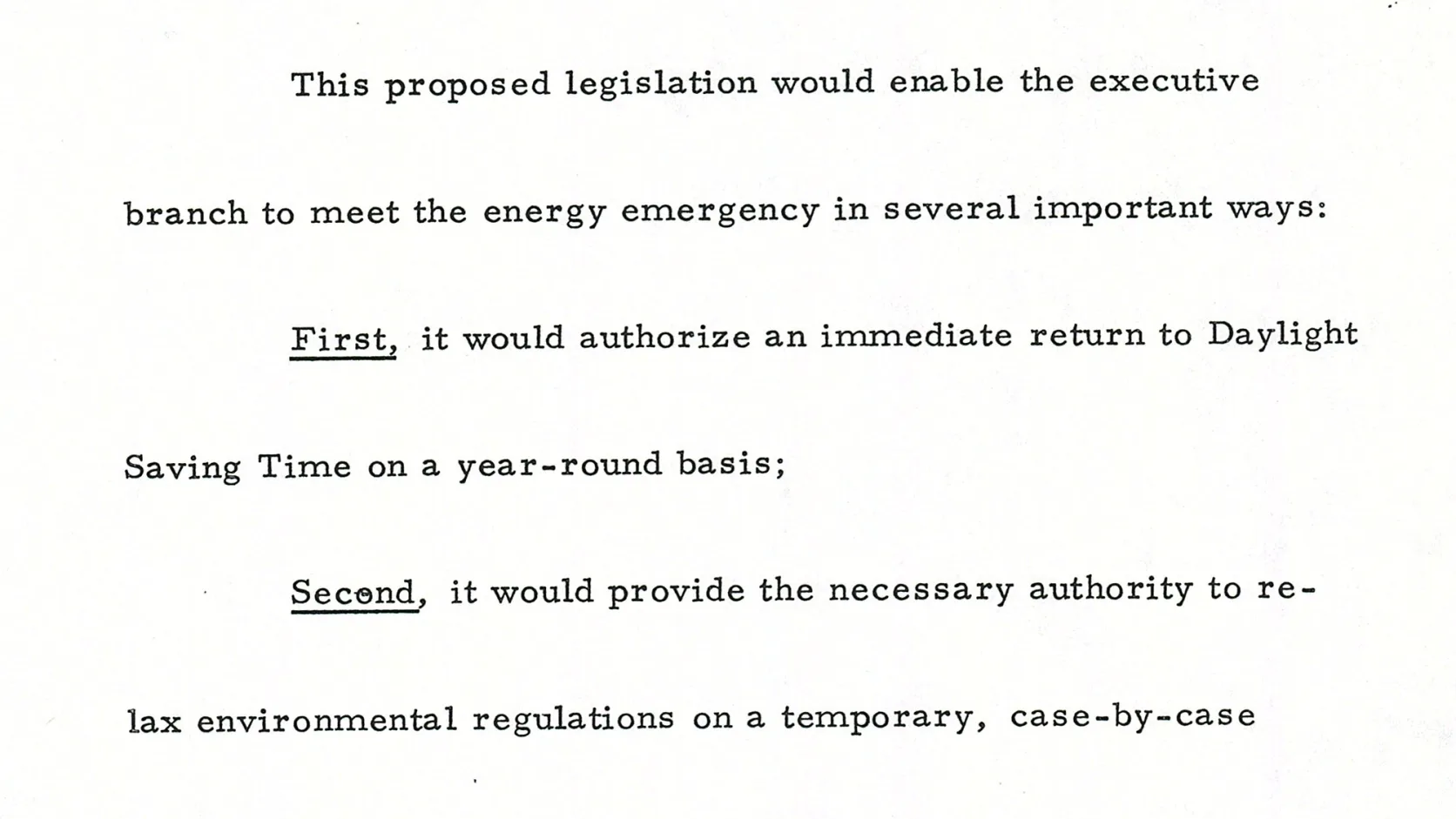
When Nixon signed the law on December 15, he said it would save "an estimated equivalent of 150,000 barrels of oil a day" during the winter months. That was a forecast, not a measurement. The Department of Transportation's 1975 study later estimated an electricity saving of about 1 percent in March and April and could not detect any effect on gasoline use. The National Bureau of Standards, asked by Congress to review that study, found no significant energy savings.
The dark-morning problem
Moving the clock does not add daylight. It moves the same daylight from the morning to the evening. In summer, that is easy to like. In January, it means sunrise arrives an hour later on the clock, and in many places that pushed it past the start of school.
The Department of Transportation's own 1974 interim report listed January 1 sunrise times under year-round daylight saving time. Detroit's was 9:02 a.m. Atlanta's was 8:42, and Bismarck, North Dakota, did not see the sun until 9:28.
The survey results followed the sunrise. The same federal report that found 79 percent approval in December recorded the reversal a month after the switch: "50% of the adults said they disliked it, and only 42% expressed a liking for YRDST. The primary reason for opposition to YRDST was that children have to go to school in the dark." The two surveys asked slightly different questions, one about preference and one about liking it, so treat them as two snapshots rather than one line on a chart. By March, with earlier sunrises, approval was back to 54 percent.
Florida and one governor's line
In its February 11, 1974 issue, TIME reported that eight Florida children had died in early-morning traffic accidents after the time change, compared with two in the same period of 1973. Governor Reubin Askew called the legislature into a special session and proposed returning most of the state to Eastern Standard Time. TIME quoted him:
"Any amount of disruption in commerce would be small indeed when compared to the life of even a single child."
The same TIME article noted that federal law allowed exemptions only for undue hardship, and that the Florida legislature took no action.
It is tempting to say that daylight saving time killed those children. The evidence does not support that. The National Bureau of Standards found a statistically significant increase in morning deaths of school-age children from January through April 1974 compared with 1973, then added that "this increase cannot be simply interpreted as 'DST effect,' in view of the many other factors that influence traffic fatalities." Looking at March and April on their own, it found no significant difference at all. What is well documented is the worry. The Department of Transportation's letter on the reversal and the White House memo that went to President Ford both cite the safety of school children traveling to school on dark mornings.
How it ended
By the fall, Congress had heard enough. H.R. 16102 returned the country to standard time from October 27, 1974 to February 23, 1975. The House committee report cited "a majority of the public's distaste for the observance of daylight saving time during the months of November, December, January, and February." President Ford signed it on October 5, 1974. The clocks fell back three weeks later.
Your city's winter sunrise under each clock
Here is what the 1974 problem looks like with today's cities. The table shows sunrise and sunset on January 6, 2027, the coming winter, under standard time and under permanent daylight saving time. January 6 sits in the stretch of the year with the latest sunrises.
| City | Sunrise, standard time | Sunset, standard time | Sunrise, permanent DST | Sunset, permanent DST |
|---|---|---|---|---|
| Boston | 7:13 a.m. | 4:27 p.m. | 8:13 a.m. | 5:27 p.m. |
| New York | 7:20 a.m. | 4:44 p.m. | 8:20 a.m. | 5:44 p.m. |
| Washington, D.C. | 7:27 a.m. | 5:01 p.m. | 8:27 a.m. | 6:01 p.m. |
| Atlanta | 7:43 a.m. | 5:44 p.m. | 8:43 a.m. | 6:44 p.m. |
| Miami | 7:09 a.m. | 5:45 p.m. | 8:09 a.m. | 6:45 p.m. |
| Detroit | 8:01 a.m. | 5:15 p.m. | 9:01 a.m. | 6:15 p.m. |
| Indianapolis | 8:06 a.m. | 5:35 p.m. | 9:06 a.m. | 6:35 p.m. |
| Chicago | 7:18 a.m. | 4:35 p.m. | 8:18 a.m. | 5:35 p.m. |
| Dallas | 7:30 a.m. | 5:36 p.m. | 8:30 a.m. | 6:36 p.m. |
| Denver | 7:21 a.m. | 4:51 p.m. | 8:21 a.m. | 5:51 p.m. |
| Salt Lake City | 7:52 a.m. | 5:15 p.m. | 8:52 a.m. | 6:15 p.m. |
| Seattle | 7:57 a.m. | 4:34 p.m. | 8:57 a.m. | 5:34 p.m. |
| Los Angeles | 6:59 a.m. | 4:59 p.m. | 7:59 a.m. | 5:59 p.m. |
The trade is exact: every city gains an hour of evening light and loses an hour of morning light. Which side you prefer depends on your latitude, where you sit in your time zone, and when your day starts.
A second way to read it is to count mornings. Over a full year, from November 1, 2026 to October 31, 2027, here is how many days would have a sunrise at 8:00 a.m. or later.
| City | Days with sunrise at 8:00 a.m. or later, current system | Same, permanent DST |
|---|---|---|
| Boston | 0 | 53 |
| New York | 0 | 68 |
| Washington, D.C. | 0 | 83 |
| Atlanta | 0 | 121 |
| Miami | 0 | 56 |
| Detroit | 21 | 129 |
| Indianapolis | 48 | 143 |
| Chicago | 0 | 63 |
| Dallas | 0 | 99 |
| Denver | 0 | 71 |
| Salt Lake City | 0 | 120 |
| Seattle | 0 | 110 |
| Los Angeles | 0 | 0 |
Cities on the western edge of a time zone, such as Indianapolis, Detroit, Atlanta, and Salt Lake City, carry the most late mornings. Los Angeles never reaches 8:00 a.m. because it sits east of its zone's reference meridian and farther south than most of the list.
How these numbers were made. Times come from the NOAA solar position algorithm used by NOAA's Global Monitoring Laboratory solar calculator, with the standard sunrise definition of the sun's upper edge on a flat horizon, corrected for atmospheric refraction. Each city uses its downtown coordinates. Permanent DST is standard time plus one hour. The "current system" column assumes the existing federal schedule, with daylight saving time from March 14 to November 7, 2027. As a check, the same method gives a 9:01 a.m. sunrise in Detroit on January 6, 1974, within a minute of the 9:02 figure the Department of Transportation printed for January 1 of that year. Times are rounded to the minute, and local terrain or tall buildings will shift what you actually see. Calculated September 24, 2026.
What the body clock has to say
In 2020, the American Academy of Sleep Medicine published a position statement on daylight saving time. Its position is that "the U.S. should eliminate seasonal time changes in favor of a national, fixed, year-round time," and that "current evidence best supports the adoption of year-round standard time, which aligns best with human circadian biology."
The reasoning is about light. The statement calls light "the most powerful exogenous zeitgeber, or cue," for the body's internal clock, and explains that the clock tends to shift later when mornings are dark and evenings are light. Permanent daylight saving time gives many places more of both in winter. The Society for Research on Biological Rhythms reached a similar view in 2019. The academy also notes that permanent daylight saving time would undo the benefits of later start times for middle and high schools.
Those are positions from professional societies, not settled law or a guarantee about any one person's sleep. They do explain why the dark-morning complaint from 1974 still comes up whenever the question returns.
A dark-morning routine card
Whatever the clocks do, some winter mornings will start before sunrise. This card turns the light research into a routine you can try. It is a general plan, not treatment. If you have persistent sleep problems, talk with a qualified clinician.
| Step | What to do | Why |
|---|---|---|
| 1. Keep one wake time | Get up at the same time on weekdays and weekends. | CDC's first sleep habit is going to bed and getting up at the same time every day. |
| 2. Find daylight early | Once it is light out, step outside or sit by a window for part of your morning, when it is safe and practical. | Light is the strongest cue for the body clock, and morning darkness pushes it later. |
| 3. Save the hard task | If you wake before sunrise, start with an easy, setup-style task and begin your hardest focus block after you have had some daylight. | A small first step is easier to start while you are still waking up. |
| 4. Dim the evening | Turn off electronic devices at least 30 minutes before bed. | CDC lists this habit, and evening light also pushes the clock later. |
| 5. Check the ratio | Look up your city in the table above and note how many 8 a.m. or later sunrises you face. | Knowing the real number helps you plan the start of winter days instead of guessing. |
Copy it onto an index card:
- Wake time: the same every day
- First light: outside or at a window, as soon as it is light
- First task: something easy until the sun is up
- Focus block: the hardest work, after daylight
- Screens off: 30 minutes before bed
For the rest of the morning, the morning routine ideas guide has 25 small steps and a five-minute fallback plan. If winter leaves your concentration scattered, the attention span guide has a seven-day reset built around short, repeatable blocks.
Where Orbital Focus fits
Orbital Focus is a focus timer that turns a work session into a rocket launch. Pick a destination, and the farther it is, the longer you focus. The Earth on the home screen is lit by the sun's actual current position, so the line between day and night moves in real time, which makes it a quiet reminder of where daylight is right now. It will not change your sunrise. If you want a fixed block for that first post-daylight task, try the 15-minute browser timer or start an Orbital Focus mission.
Where it stands now
This section reflects the record as of September 24, 2026. The rest of the article describes 1973 to 1975 and will not change.
- The House: On July 14, 2026, the House passed H.R. 139, the Sunshine Protection Act, which would make daylight saving time permanent. The vote was 308 to 117, with 6 members not voting.
- The Senate: As of this check, the bill had been referred to the Senate Committee on Commerce, Science, and Transportation and had not received a Senate vote. The Senate passed an earlier version by unanimous consent in March 2022, but the House did not act on it before that Congress ended.
- This fall: Unless the law changes first, clocks fall back to standard time on Sunday, November 1, 2026, at 2 a.m. local time.
If the bill moves again, this section will be updated with the date of the change.
Frequently asked questions
Has the United States ever had permanent daylight saving time?
Yes, briefly. Under the Emergency Daylight Saving Time Energy Conservation Act of 1973, the country stayed on daylight saving time from January 6, 1974. The law was written for about two years, but Congress amended it, and standard time returned on October 27, 1974, after 294 days.
Why did the 1974 experiment end early?
Dark winter mornings. In the federal government's own surveys, the main objection was that children had to go to school in the dark. Support that looked strong in December 1973 fell after January, and Congress voted to restore standard time from October 27, 1974 to February 23, 1975.
Did year-round daylight saving time cause the Florida school-child deaths in 1974?
That was never established. Eight Florida children died in early-morning traffic in the weeks after the change, compared with two in the same period of 1973. A 1976 National Bureau of Standards review found more morning deaths of school-age children from January to April 1974 but said the increase could not simply be read as a daylight saving time effect.
Did year-round daylight saving time save energy in 1974?
Not much that anyone could measure. The Department of Transportation's 1975 study estimated about a 1 percent saving in electricity for March and April and could not detect a gasoline effect. The National Bureau of Standards review that followed found no significant energy savings.
Is permanent standard time better for sleep?
The American Academy of Sleep Medicine says so. Its 2020 position statement concludes that year-round standard time aligns best with human circadian biology, because morning light is the strongest cue for the body clock. That is a professional society's position, and individual sleep problems still belong with a clinician.
Sources and method
All sources were checked on September 24, 2026, unless another date is given.
- Nixon, Address to the Nation About Policies To Deal With the Energy Shortages, November 7, 1973, The American Presidency Project.
- Nixon, Statement on Signing the Emergency Daylight Saving Time Energy Conservation Act of 1973, December 15, 1973, The American Presidency Project. Source of the signing date, start date, two-year term, and 150,000-barrel estimate.
- U.S. Department of Transportation, Year-Round Daylight Saving Time Study, Volume 1, Interim Report, June 1974. Table 4-1 (January 1 sunrise times) and section 5.1 (the NORC surveys: 79 percent in December 1973, 42 percent like and 50 percent dislike in February 1974, 54 and 38 percent in March).
- U.S. Department of Transportation, The Daylight Saving Time Study, Executive Summary, July 1975. Electricity and gasoline findings.
- TIME, "The Nation: Daylight Disaster Time?", February 11, 1974. Florida figures and Governor Askew's quote.
- Congressional Research Service, Daylight Saving Time (R45208), which quotes the National Bureau of Standards' 1976 report to Congress on energy savings and traffic fatalities.
- Gerald R. Ford Library, bill file for H.R. 16102, October 1974, and the White House press notice of October 5, 1974.
- Rishi and colleagues, "Daylight saving time: an American Academy of Sleep Medicine position statement," Journal of Clinical Sleep Medicine, 2020.
- Roenneberg and colleagues, "Why Should We Abolish Daylight Saving Time?" Journal of Biological Rhythms, 2019, the Society for Research on Biological Rhythms position paper.
- CDC, About Sleep, for the consistent-schedule and screens-off habits.
- NOAA Global Monitoring Laboratory, Solar Calculator, whose published algorithm produced the sunrise tables.
- Office of the Clerk, U.S. House, Roll Call 238, July 14, 2026, and Congress.gov, H.R. 139.
- 15 U.S.C. 260a, which sets the current daylight saving time schedule.
Images: the hero photo is by Jack Corn for the EPA's DOCUMERICA project (National Archives, NARA 556588). The speech draft is from the Nixon Library (National Archives, NAID 567832262). Both are U.S. government works in the public domain. The photo shows an ordinary 1974 school morning, not any child named in this article.
Corrections are welcome at habib225@gmail.com.

Give your next focus block a destination.
Pick a mission length, launch, and keep distracting apps sealed until you arrive.
 Apollo 11 Quiz
 Apollo 12 Lightning Strike
 Focus Science Quiz
 One-Minute Mental Reset