 Orbital Focus
How to Fix Your Attention Span Without Pretending It Is a Battery
Attention is not a single score you repair once. It is a behavior you can make easier with fewer cues, smaller starts, and blocks that grow only when you are ready.
 By Chris HabibUpdated 9 min read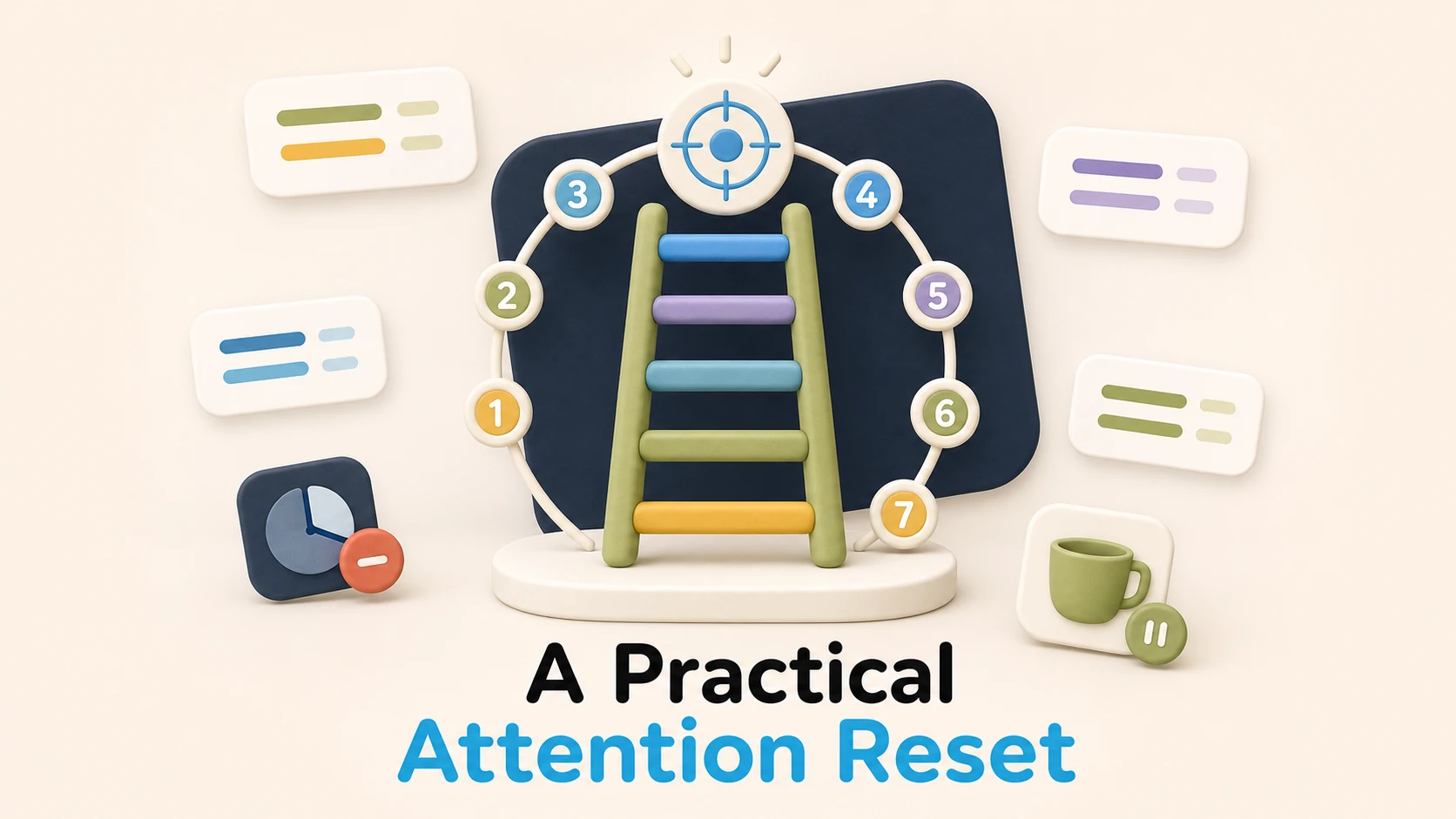
Attention does not behave like a phone battery. You cannot drain it to 4 percent, charge it overnight, and wake up with a permanently larger capacity. What you can change is the situation in which attention has to work: the number of cues competing for it, the size of the first action, the length of the block, and the quality of the break.
That is good news. It gives you something more useful than a viral claim about a shrinking human attention span.
What this guide can and cannot do
Red Honey publishes this guide and the linked attention task. The task is an educational, SART-style go/no-go exercise. It can show misses, false taps, reaction-time variation, and change during one short run. It cannot measure your whole attention span, diagnose ADHD, or tell you why focusing feels difficult.
Take a useful baseline
Run the free attention-span task once in a quiet room. Do not treat the result as a grade. Record the conditions around it.
| Record | Why it matters |
|---|---|
| Hours and quality of sleep | CDC notes that sufficient, good-quality sleep supports attention and memory |
| Missed targets | You may have looked away, drifted, or misunderstood a stimulus |
| False taps | Fast responding can trade accuracy for speed |
| Reaction-time variation | Averages can hide a few very slow responses |
| Interruptions | A notification and a wandering thought are different events |
| Time of day | A morning run and an end-of-day run are not directly comparable |
The task borrows its shape from the Sustained Attention to Response Task. In the classic version, people respond to frequent items and withhold a response to a rare target. Researchers have debated what the result represents. Some studies connect it with everyday attention failures; others find that response strategy and the speed-accuracy tradeoff matter a great deal. That debate is why this site's result is labeled as a snapshot, not a diagnosis.
Run it again only after the seven-day experiment below, under similar conditions. Repeating it five times in a row mostly trains you on the task.
The seven-day attention reset
This is not a detox. Nothing is leaving your bloodstream. It is a small environmental experiment.
| Day | Change | Focus block | What to write down |
|---|---|---|---|
| 1 | Baseline only | 10 minutes | Starts, interruptions, and where you stopped |
| 2 | Silence non-human notifications | 10 minutes | Which alert you expected to see |
| 3 | Put the tempting device out of reach | 10 minutes | Every urge to retrieve it |
| 4 | Write one visible finish line | 15 minutes | Whether the first action was obvious |
| 5 | Use a paper interruption list | 15 minutes | Ideas that tried to pull you away |
| 6 | Replace the feed break with movement | 15 minutes | Energy before and after the break |
| 7 | Repeat the best conditions | 20 minutes | Which change earned a permanent place |
For each block, name a result instead of a subject. "Draft the opening paragraph" gives attention somewhere to land. "Work on essay" does not.
You can use the 10-minute browser timer for the first three days, then move to the 15-minute timer. If a 25-minute block already feels comfortable, the Pomodoro technique guide explains how to add breaks without turning the clock into another task manager.
The one-page reset card
Copy this into a note or onto an index card:
- Outcome: What visible result will exist when the block ends?
- First action: What can I do in under two minutes?
- Removed cue: Which app, tab, notification, or device is unavailable?
- Parking list: Where will unrelated thoughts wait?
- Duration: What is the shortest honest block?
- Break: What will I do that is not another feed?
- Restart note: What is the first action next time?
The productivity tips guide develops the restart note and parking-list ideas into a daily operating card.
Build a focus-block ladder
Do not increase duration because a chart says you should. Increase it after the current rung is repeatable.
| Rung | Work | Break | Move up when... |
|---|---|---|---|
| 1 | 10 min | 3 min | You complete three blocks without reaching for the removed distraction |
| 2 | 15 min | 5 min | The finish line still fits and restarting feels possible |
| 3 | 25 min | 5 min | You can protect the block without constant clock checking |
| 4 | 45 min | 10 min | Setup time makes shorter blocks wasteful |
| 5 | 60 to 90 min | 15 to 20 min | The task benefits from continuity and recovery stays intact |
Moving down is not failure. A 10-minute block on a bad day is a working system. A 90-minute plan you avoid all afternoon is not.
Longer sessions also need real breaks. Stand up. Walk. Drink water. Look at something farther away than the screen. Opening a short-video feed changes the task but keeps your attention in a high-switching environment.
When to look beyond a focus routine
Low concentration by itself does not identify a cause. Sleep problems, stress, anxiety, depression, medication effects, substance use, pain, and physical illness can all change how focusing feels.
The National Institute of Mental Health describes adult ADHD as a persistent pattern of inattention and/or hyperactivity and impulsivity that interferes in at least two areas of life. Diagnosis looks at current and childhood history, interviews, rating scales, and other possible explanations. One browser score is not part of a shortcut around that process.
Talk with a qualified health professional when attention problems are persistent, appear across settings, or are interfering with school, work, relationships, driving, or basic care. Seek urgent help when concentration changes suddenly with confusion, weakness, a severe headache, a head injury, or another acute symptom.
Frequently asked questions
Is low attention span ADHD?
Not by itself. Many things can make attention harder, including poor sleep, stress, depression, anxiety, medication effects, substance use, and a badly designed environment. NIMH describes ADHD as a persistent pattern that interferes with daily life in more than one setting, with symptoms that began in childhood. A short attention task or a rough week cannot diagnose it.
Why does Gen Z have a low attention span?
That claim treats a large generation as if everyone shares one measurable attention span. They do not. Fast feeds, constant notifications, sleep, stress, school or work demands, and the task itself all change how attention looks. Measure your own conditions and behavior instead of borrowing a viral number about an age group.
How can I train my attention span?
Make one task easy to start, remove the most tempting cue, use a short timed block, and stop while the plan is still repeatable. Repeat the same block three times before adding five minutes. Sleep, movement, and breaks support the process, but no single drill permanently expands a fixed attention tank.
Sources and method
- NIMH: ADHD in Adults, 4 Things to Know, checked August 25, 2026.
- CDC: About Sleep, checked August 25, 2026. CDC lists improved attention and memory among the benefits of sufficient sleep and recommends at least seven hours for adults ages 18 to 60.
- Manly and colleagues: further investigations of sustained attention to response00127-4), the classic SART paper.
- Helton, Kern, and Walker: Conscious thought and the sustained attention to response task, which discusses the role of response strategy and speed versus accuracy.
- Physical Activity Guidelines for Americans, second edition, which summarizes evidence linking regular physical activity with cognition, including attention.
Corrections are welcome at habib225@gmail.com. Ready for a fixed session instead of another test? Start an Orbital Focus mission.

Give your next focus block a destination.
Pick a mission length, launch, and keep distracting apps sealed until you arrive.
 How to Brain Dump
 25 Morning Routine Ideas
 The 8 Best ADHD Focus Apps
 The 7 Best iPhone App Blockers