 Orbital Focus
Productivity Tips for People Who Do Not Need Another Perfect System
A useful productivity system does not make every hour efficient. It makes the important task easier to start, harder to interrupt, and clear enough to finish.
 By Chris HabibUpdated 11 min read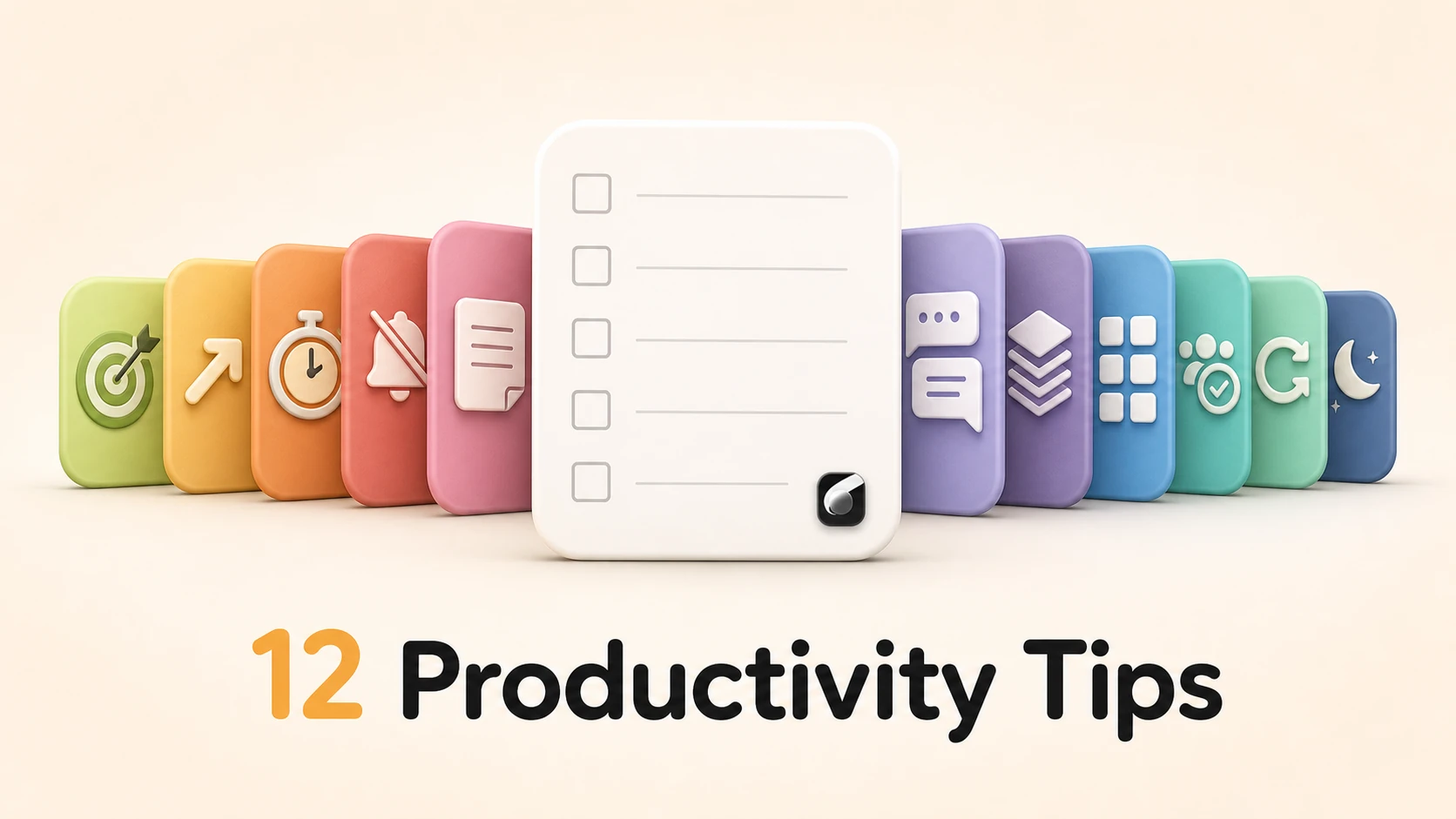
The bottom line
Pick one outcome, write the first physical action, protect one timed block, and end by leaving a restart note. A smaller system you repeat beats a larger one you spend the day maintaining.
You probably do not need a more beautiful system. You need the important task to be easier to start, harder to interrupt, and clear enough to resume tomorrow.
The twelve practices below are deliberately small. Pick the one that fixes the point where work currently stalls. Keep it for a week before adding another.
The one-page operating card
Copy this into a note each morning:
| Field | Your answer |
|---|---|
| One result that makes today count | |
| First physical action | |
| Protected block and duration | |
| Distraction removed | |
| Parking list location | |
| Maintenance tasks that still matter | |
| Restart note before stopping |
The card is the keepable system. Everything below helps you fill one row.
1. Write an outcome, not a topic
“Budget” is a subject. “Reconcile July transactions and list the three unmatched charges” is an outcome. A visible result removes the first round of interpretation when the work block begins.
Ask: What will exist that does not exist now? Use a verb and an object. If the result cannot fit the time available, make it smaller before starting.
2. Name the first physical action
Turn “prepare presentation” into “open the current deck and write the decision on slide one.” The first action should be observable and begin in under two minutes. It does not need to be impressive. It needs to make the second action easier to see.
3. Protect one block, not the whole day
Choose a duration the task can use and you can honestly begin. Ten minutes is enough for a restart. Twenty-five minutes is useful when starting is the main problem. Fifty minutes can preserve continuity for writing or analysis.
Use the 25-minute timer or choose a different interval in the Pomodoro technique guide. Protecting one repeatable block beats declaring an entire day distraction-free and abandoning the plan at 10:15.
4. Remove the cue before relying on restraint
Silence non-human notifications. Close the inbox. Put the phone beyond arm's reach. If one app repeatedly breaks the block, use the iPhone blocking walkthrough or a website rule rather than conducting the same argument with an icon every five minutes.
The goal is not moral purity. It is fewer decisions during the period reserved for one task.
5. Keep a paper or single-file parking list
When an unrelated task appears, write it down and return. The list tells your brain the thought will not be lost without making you open another app.
Use one sheet or one plain file. A parking list that requires choosing tags, projects, due dates, and icons becomes a task switch in its own right.
6. Batch small communication windows
Do not promise to ignore every message all day. Set one or two clear windows to read and answer them. Tell collaborators when a fast response is actually required and how an urgent issue should reach you.
This works only when the window is real. If you secretly check throughout the focus block, there is no batch.
7. Reduce active goals
An endless project list is not the same as an active project list. Keep many obligations in storage if necessary, but choose a small number that can receive work this week.
Classic task-switching experiments found measurable costs when people alternated between rules compared with repeating the same task. That does not prove every real-world switch wastes a fixed number of minutes. It does support a practical point: changing goals requires control processes, so group related actions when you can.
8. Use the 1-3-5 rule as a ceiling
The informal 1-3-5 rule means one large task, three medium tasks, and five small tasks. Use it to cap a list, not to create a nine-item quota.
On a meeting-heavy day, one large and one small item may be full capacity. A rule that ignores the calendar is not planning.
9. Use 3-3-3 only after defining the units
There is no single official 3-3-3 method. One useful version is three hours on priority work, three shorter maintenance tasks, and three small upkeep actions. Another person may use different units.
Write your version at the top of the page. If three hours is unrealistic, use three 30-minute blocks. The constraint should reveal a priority, not manufacture guilt.
10. Make meetings produce a decision
Before a meeting, write the decision, information, or coordination it exists to produce. End with an owner and next action. If the purpose is only status, consider whether a written update is clearer.
Meetings are not inherently unproductive. Meetings without an expected result are hard to prepare for and easy to repeat.
11. Leave a restart note
Before stopping, write:
- the next visible action;
- the file, page, or location;
- the unresolved question; and
- the smallest context your future self will need.
This makes tomorrow's first minute useful. It is especially valuable when you must stop in the middle of good work.
12. Protect recovery as part of the system
Sleep, movement, food, and human connection are not rewards for finishing the list. CDC says sufficient sleep supports attention and memory, and US physical-activity guidance summarizes benefits for cognition and health.
Do not build a productivity plan that depends on chronic sleep loss. A 20-minute block after a decent night's sleep may produce better work than a heroic late-night schedule you cannot repeat. The attention-span guide turns sleep, cues, and breaks into a seven-day experiment.
A seven-day implementation plan
| Day | Keep one change | Evidence to record |
|---|---|---|
| 1 | Write one outcome | Did the first action become obvious? |
| 2 | Add a protected timer | Did you start when planned? |
| 3 | Remove one cue | How many unplanned opens occurred? |
| 4 | Use a parking list | What tried to interrupt the block? |
| 5 | Batch messages | Were urgent routes still available? |
| 6 | Leave a restart note | How fast did the next session begin? |
| 7 | Keep only the best change | Which behavior improved without extra maintenance? |
Frequently asked questions
What is the 3-3-3 rule for productivity?
There is no single official 3-3-3 method. A useful version is three hours on the most important work, three shorter maintenance tasks, and three small upkeep actions. Treat it as a planning constraint, not a scientific law, and shrink each group when your day cannot support that load.
Do people with ADHD struggle with productivity?
ADHD can make attention, organization, time management, task initiation, and follow-through harder, but people and days vary. NIMH describes a diagnosis as a persistent pattern that interferes across areas of life, not a character flaw or a low-output day. External cues, smaller actions, visual time, and qualified clinical support can address different parts of the problem.
What are the biggest productivity killers?
The common ones are unclear outcomes, tasks that are too large to start, frequent notifications, switching between active goals, meetings without decisions, and too little recovery. The useful question is which one appears before your own work stalls. Track that point for a week and fix one repeated cause.
What is the 1-3-5 rule for productivity?
Plan one large task, three medium tasks, and five small tasks for the day. It is a capacity limit, not a quota. If the large task takes most of the day, reduce the rest. The rule is helpful when it prevents an endless list, and unhelpful when nine items become another standard you feel required to meet.
Sources and scope
- Rubinstein, Meyer, and Evans: Executive control of cognitive processes in task switching, a 2001 primary study of task switching.
- NIMH: ADHD in Adults, 4 Things to Know, checked August 25, 2026.
- CDC: About Sleep, checked August 25, 2026.
- Physical Activity Guidelines for Americans, second edition, an official evidence review.
The 1-3-5 and 3-3-3 rules are informal planning conventions, not validated clinical protocols. Send a correction to habib225@gmail.com. Ready for one visible finish line? Start an Orbital Focus mission.

Give your next focus block a destination.
Pick a mission length, launch, and keep distracting apps sealed until you arrive.
 How to Brain Dump
 25 Morning Routine Ideas
 The 8 Best ADHD Focus Apps
 The 7 Best iPhone App Blockers