 Orbital Focus
Monk Mode Without the Internet Theater: A Bounded Focus Sprint
Monk mode is an internet label, not a clinical protocol. The useful version is a short season with fewer optional inputs and one protected priority, not social disappearance or punishment.
 By Chris HabibUpdated 9 min read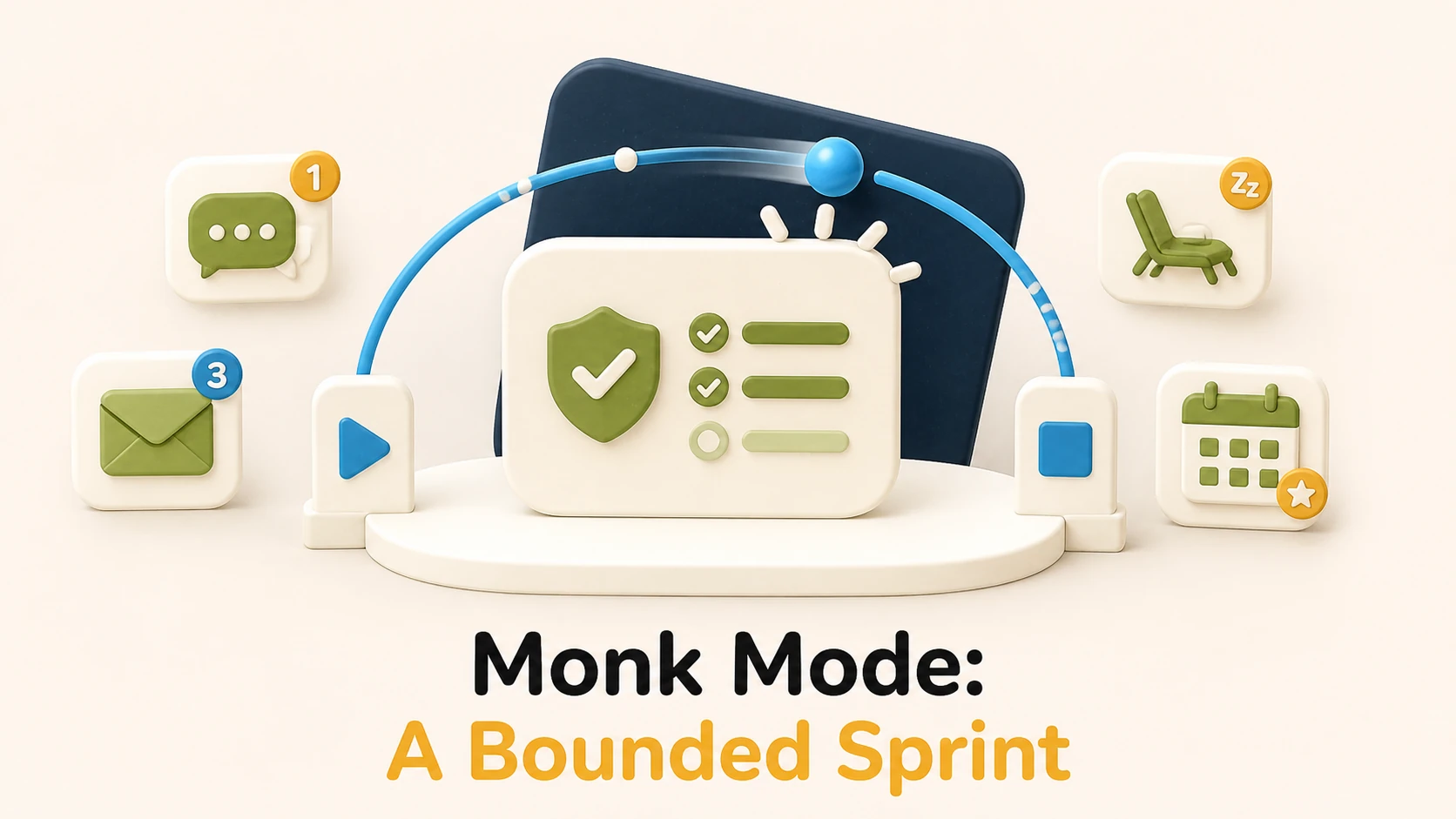
The bottom line
Run monk mode as a 7- or 14-day sprint. Pick one priority, one daily protected block, one communication window, and one end date. Keep sleep, meals, movement, relationships, and necessary care inside the plan.
“Monk mode” is an internet label, not a clinical protocol and not a single method with official rules. The useful version is much less dramatic than the videos: one priority, fewer optional inputs, a daily protected block, and a written end date.
It should not require disappearing from people who depend on you, sleeping less, skipping care, or treating misery as evidence of commitment.
The bounded version
Use monk mode as a 7- or 14-day experiment. Keep the rest of life intact.
| Keep | Reduce during the sprint | Never treat as optional |
|---|---|---|
| One priority project | Unplanned social feeds | Sleep and food |
| One daily focus block | Optional entertainment during the block | Medication and medical care |
| One communication window | Nonessential notifications | People who rely on you |
| Movement and recovery | New side projects | Emergency access |
| A written review date | Public performance of the routine | Work or school safety rules |
The aim is to make one important behavior easier to repeat. Isolation is not the product.
Write a boundary card
Copy and complete this before day one:
- Priority: For the next ___ days, this sprint supports ___
- Daily block: From ___ to ___, I will work on ___
- Paused inputs: During that block, I will not open ___
- Still available: Phone, messages from ___, maps, authentication, and ___
- Communication window: I will check and respond at ___
- Urgent route: People can reach me by ___
- Recovery floor: I will protect ___ hours of sleep and ___ movement
- End date: I will review this on ___
- Exit condition: I will stop early if ___
If you cannot explain the boundary to someone affected by it, the boundary is not ready.
Set up a 7-day sprint
1. Choose one priority
Name a project or behavior, not a new identity. “Finish the proposal draft” is testable. “Become disciplined” has no endpoint.
2. Choose a daily block
Use the same reasonable window when possible. Start with the 45-minute timer if a longer interval feels useful, or use the Pomodoro guide when starting is the harder part.
3. Remove only the relevant paths
Silence notifications, close unrelated tabs, and block the feed that repeatedly captures the block. The website-blocking guide shows how to cover the browser path without sealing the whole device.
4. Preserve communication
Tell affected people when you will respond and how an urgent issue should reach you. The US Surgeon General's advisory on social connection describes social disconnection as a meaningful health concern. A focus experiment should not turn necessary relationships into collateral damage.
5. Review at the written end date
Compare completed priority work, sleep, mood, movement, missed commitments, and relationship friction. Keep only the boundary that helped without creating a larger problem.
What to measure
| Measure | Daily question |
|---|---|
| Starts | Did the protected block begin when planned? |
| Priority output | What visible result exists? |
| Overrides | Which paused input did I reopen, and why? |
| Sleep | Did the sprint reduce my planned sleep? |
| Connection | Did I miss a necessary commitment or message? |
| Recovery | Did I move, eat, and take a real break? |
Do not measure how extreme the routine looked. Measure whether the priority moved and the rest of your functioning remained stable.
Stop or change the sprint when
End the experiment early if it repeatedly causes sleep loss, skipped meals or medication, missed caregiving, unsafe driving or work, worsening mental health, or avoidance of people who need you. A boundary that damages basic functioning is not made better by a catchy name.
Persistent concentration problems, distress, or major changes in sleep and mood belong in a conversation with a qualified health professional. A productivity routine is not diagnosis or treatment.
For a less intensive reset, use the seven-day plan in how to fix your attention span. For a single protected work period, review the best focus apps instead of redesigning a whole week.
Frequently asked questions
What does it mean to go monk mode?
Online, monk mode usually means temporarily reducing optional entertainment, social media, and other distractions to concentrate on one priority. There is no standard rulebook. A useful version is written, time-limited, and specific about what stays available, who can reach you, and when the experiment ends.
Is monk mode healthy?
It can be a reasonable short focus experiment if it protects sleep, food, movement, relationships, medical care, and necessary communication. It becomes a bad plan when isolation, sleep loss, overwork, or punishment are treated as proof of commitment. Stop if the routine makes daily functioning or mental health worse.
What is monk Mode?
Monk mode is a popular name for a period of reduced distraction and concentrated work. It is not a formal productivity method, diagnosis, or treatment. In this guide, it means a bounded sprint with one priority, one protected block each day, and explicit recovery and exit rules.
What are the rules of monk Mode?
There are no universal rules. Use five: choose one priority, set an end date, protect one daily block, define a communication window, and keep basic health and relationship commitments. Write exceptions before the sprint so an urgent need does not become a debate with your past self.
Sources and scope
- CDC: About Sleep, checked August 25, 2026.
- Physical Activity Guidelines for Americans, second edition.
- US Surgeon General: Our Epidemic of Loneliness and Isolation, an official advisory on social connection.
- NIMH: My Mental Health, Do I Need Help?, for signs that deserve professional support.
“Monk mode” itself has no official owner or universal evidence-based protocol. This guide defines a bounded editorial version so the rules and exit are explicit. Send corrections to habib225@gmail.com. Ready for one protected block? Start an Orbital Focus mission.

Give your next focus block a destination.
Pick a mission length, launch, and keep distracting apps sealed until you arrive.
 How to Brain Dump
 25 Morning Routine Ideas
 The 8 Best ADHD Focus Apps
 The 7 Best iPhone App Blockers